

Adapted by:
Miguel Jorge
WriterJournalist. I've spent more than half of my life writing about technology, science, and culture. Before landing here, I worked at Telefónica, Prisa, Globus Comunicación, Hipertextual, and Gizmodo. I'm part of Webedia's cross-section team.

Alba Mora
WriterAn established tech journalist, I entered the world of consumer tech by chance in 2018. In my writing and translating career, I've also covered a diverse range of topics, including entertainment, travel, science, and the economy.
For a long time, it was widely believed that there were 8 billion people on the planet. A recent study estimated that there are actually 1 to 3 billion more people. In any case, we live in an overcrowded world. Most of the population resides in cities, which further complicates things. One city holds two remarkable records: It’s both the largest and the most populated. However, you may have never heard of it.
Colossal and unknown. When asked about the world’s largest city, many might mention London, New York City, and Tokyo. However, none of these well-known cities hold the title for largest by either total population or area. The true urban giant resides in China, and its name may be unfamiliar to most: Chongqing.
This monumental metropolis is located in Southwestern China, where the Yangtze and Jialing rivers converge. It’s not only the most populous city in its jurisdiction but also the largest on the planet. Chongqing spans over 31,000 square miles, which is comparable to the area of South Carolina, or entire countries such as Ireland and Austria.
Context. However, its actual size isn’t easily perceived from the outside. This is primarily because much of its territory is rural, and its urban structure also defies conventional mapping logic. The city is built on steep slopes, deep valleys, and elevated platforms. Residents have to navigate a labyrinth of tunnels, cable cars, stairs, elevators, and walkways that crisscross in an endless vertical maze.
A city in three dimensions. Chongqing is a three-dimensional urban phenomenon, as vertical as it is expansive, and as abrupt as it is overwhelming. The Guardian compares it to a mix of Christopher Nolan’s movie Inception and a game of snakes and ladders. In Chongqing, what seems to be a first floor can actually be the rooftop of a thirty-story building. Moving just a few blocks can involve changing levels multiple times.
Far from following traditional patterns, the urban layout is shaped by the mountainous terrain. This forces neighborhoods to cling to cliffs and subway lines to pass through residential buildings. In this context, even maps lose significance. The city can only be understood in motion, from within and in all directions.
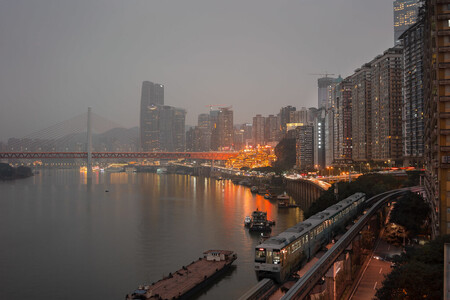 Chongqing at dusk.
Not a mere statistic. While it may seem that its classification as “the largest” city is based on administrative technicalities, the reality goes beyond mere surface area. The urban area itself occupies a much smaller portion of the total land. However, more than 70% of the population (around 33 million inhabitants) lives within that concentrated area, surpassing any other city in the world.
Moreover, Chongqing isn’t a recent development or a city planned overnight. Its history spans more than 3,000 years. It’s played a key role as a regional capital, strategic river port, and logistical hub even before the Qing dynasty. The city had more than two million inhabitants before the economic reforms of 1968 opened China to globalization. Since then, its growth has been quick. The population reached 6.3 million in 1979, 13.9 million in 1983, and nearly 29 million in 1997.

Urbanized China. Chongqing also symbolizes the ideal model of intensive urbanization that China has promoted in recent decades. The state machinery has doubled the country’s urbanization rate in 20 years, projecting an urban population of 70% by 2050. Currently, four of the world’s five largest cities by population fall within its administrative boundaries. This illustrates a national trend where economic development is closely tied to urban planning on a continental scale.
In this context, Chongqing isn’t just a statistical success. It’s a crucial element of China’s economic and territorial framework. It’s a sort of megalopolis built on substantial public investment, administrative reorganization, and forced relocation to urban centers.
Chongqing’s future. Like many other major Chinese cities, Chongqing is confronting a new reality of stagnation and demographic decline. Despite its immense size and significant role in the nation’s economic growth, it may have already reached its peak.
Younger generations are fewer in number and hold different goals and values. They might also lessen the demand for expansion that has characterized its recent history. However, even if it no longer grows, Chongqing will still be a unique city. With 33 million people and a territory larger than some countries combined, it stands as one of the most extraordinary urban expressions humanity has ever conceived.
Images | Iewek Gnos | Kristoffer Trolle
Related | The Australian City of Darwin Has a Population of 250,000, Including 100,000 Wild Crocodiles