
Adapted by:
Javier Pastor
Senior WriterComputer scientist turned tech journalist. I've written about almost everything related to technology, but I specialize in hardware, operating systems and cryptocurrencies. I like writing about tech so much that I do it both for Xataka and Incognitosis, my personal blog.

Alba Mora
WriterAn established tech journalist, I entered the world of consumer tech by chance in 2018. In my writing and translating career, I've also covered a diverse range of topics, including entertainment, travel, science, and the economy.
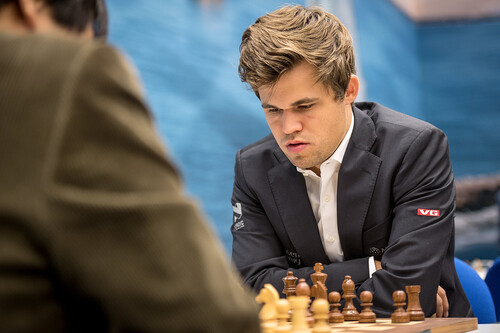
On April 4, a very special freestyle chess game began. It featured Magnus Carlsen, widely regarded as the greatest chess player in history, who played with the white pieces. The black pieces were controlled by the entire world, which successfully managed to force a draw.
Carlsen can’t defeat the world. On May 20, the game concluded with an unexpected outcome. After 32 moves, “The World” achieved a draw in a queen endgame, using the threefold repetition rule. This rule allows a player to claim a draw if the same position on the board occurs at least three times during the game.
Magnus vs. The World. Online chess platform Chess.com organized the event. It brought together more than 143,000 Chess.com users who collaborated in an attempt to outplay Carlsen.
Freestyle chess. Traditional chess rules didn’t apply in the game. Instead, players followed a new freestyle chess format that Carlsen is promoting. In this format, the positions of the pieces in the back row (rooks, knights, bishops, queen, and king) are chosen randomly.
However, there are two crucial rules. First, bishops must be placed on squares of different colors. Second, castling is permissible on both sides, meaning the king must always remain between the two rooks.
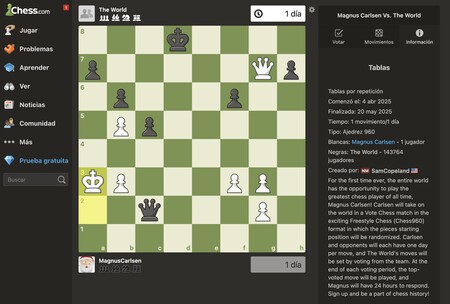 The game between Carlsen and “The World” ended in a draw by repetition.
A legend. Carlsen, now 34, became the world’s top-rated chess player in 2010 at the age of 19. Since then, he’s won five world championships. In 2014, he achieved the highest Elo rating in history, reaching 2,882 points.
In recent years, tensions with the International Chess Federation and a lack of motivation for classical chess have led him to step back from defending his title as world champion. Although he still participates in classical chess tournaments, he’s developed a keen interest in rapid tournaments. Additionally, he’s recently focused on promoting the freestyle variant, also known as Chess960 or Fischer Random Chess.
Voting system. After each of Carlsen’s moves, “The World” had 24 hours to vote on the next move. Participation in each vote wasn’t mandatory. To assist "The World" players, several coaches provided their insights and analyses of the best possible moves based on the state of the game.

A “sound” game. “Overall, The World has played very, very sound chess. Kind of from the start, maybe not going for the most enterprising options, but keeping it in the vein of normal chess. It's not always the best strategy, but it seemed like it worked fine this time,” Carlsen said after the game.
No risks. In the final moves, “The World” players debated whether to force a draw using the threefold repetition rule or to continue playing for a win, even at the risk of losing. In the end, the majority voted in favor of the more conservative approach, opting to secure the draw.
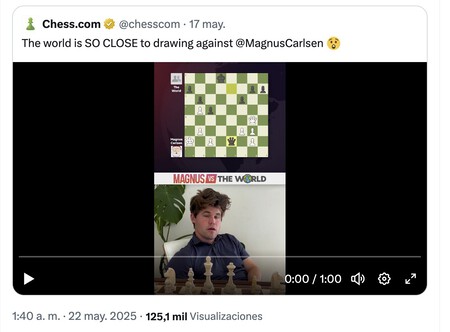 Click on the image to view the original post on X.
Defeats against Kasparov and Anand. This isn’t the first game of its kind. In 1999, Russian chess player Garry Kasparov played against over 50,000 players via Microsoft Network and emerged victorious after four months. Similarly, in 2024, Indian grandmaster Viswanathan Anand defeated more than 70,000 players on Chess.com. Both events feature classical chess games.
How did the game go? Chess.com analysts have described the game as a “roller coaster” with several dramatic moments. At one point, Carlsen held a somewhat advantageous position but was unable to capitalize on it. In the end, he said that everything pointed toward a draw because “they didn’t give me a single chance.”
Image | Frans Peeters