
Adapted by:
Javier Pastor
Senior WriterComputer scientist turned tech journalist. I've written about almost everything related to technology, but I specialize in hardware, operating systems and cryptocurrencies. I like writing about tech so much that I do it both for Xataka and Incognitosis, my personal blog.

Alba Mora
WriterAn established tech journalist, I entered the world of consumer tech by chance in 2018. In my writing and translating career, I've also covered a diverse range of topics, including entertainment, travel, science, and the economy.
Many people have the latest versions of Windows, macOS, Android, and iOS installed on their PCs, laptops, and mobile devices. It almost feels inconceivable to use outdated operating systems. However, whether directly or indirectly, we frequently rely on them. Many critical systems are still using older versions of Windows.
Stuck in the past. The BBC recently reported on society’s ongoing dependence on these outdated operating systems for essential functions. This issue affects not only companies but also end users, who are often compelled to use old systems not out of preference but out of necessity.
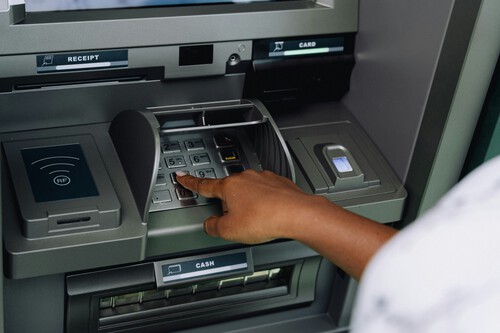
ATMs. This is a classic example of technology relying on outdated operating systems. In 2014, it was reported that 89% of ATMs in Europe were operating on Windows XP. Some were still using Windows NT, which was introduced in 1993.
ATM expert Elvis Montiero explained the challenges of upgrading:
“The challenge with upgrading these machines lies in the high costs associated with hardware compatibility, regulatory complaince and the need to rewrite proprietary ATM software.”
Security issues. The situation has improved, and ATMs typically use Windows 10 IoT Enterprise LTSC. This guarantees security updates for another seven years. However, many machines still run on Windows 7 Embedded and earlier versions, posing significant security risks. Vulnerabilities in these outdated systems can make them targets for sophisticated attacks.
Trains running Windows 95. Several train control systems in Sweden still operate on Windows XP, which was launched in 2001. Some are even reliant on the much older Windows 95. Meanwhile, Deutsche Bahn, Germany’s national railway, was recently looking for a system administrator with experience in Windows 3.11 and MS-DOS. This highlights just how outdated some systems can be.
In San Francisco, some trains require a floppy disk to be inserted every morning to operate. Japan also has its share of aging technology in railway systems.
Airports on ancient Windows. Other infrastructures also rely on these outdated systems. Social media users often share examples of Windows XP operating on screens at different airports and at gate terminals. More surprisingly, in 2015, the French DECOR system for air traffic controllers was revealed to run on Windows 3.1.

Hospitals and public agencies. The issue also impacts critical public infrastructure, including hospitals. In 2016, the U.S. was still relying on 8-inch floppy disks and 1970s-era computers to manage its nuclear weapons.
Companies. This situation isn’t limited to public systems. Private companies are also affected by outdated technology. Many are stuck using old versions of Windows to maintain compatibility with certain apps and peripherals. For instance, John Watts, who operates a professional print shop, depends on Windows 2000 to control two large LightJet printers.
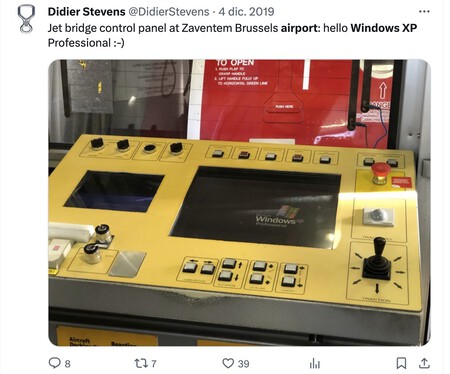 Click on the image to view the original post on X.
Better not upgrade. Psychiatrist Eric Zabriskie used to arrive at his office 15 minutes early because his computer took that long to boot up. This is a common challenge for many companies. They refrain from updating their devices due to a lack of resources or time, leaving them with obsolete systems that pose significant risks.
In Zabriskie’s case, he works for the Department of Veterans Affairs, which uses a system called the Computerized Patient Record System, based on MS-DOS.
Versatility comes at a cost. This issue primarily occurs with Windows systems, although it can also affect Linux environments. There’s a clear reason for this trend. Microsoft has long been the preferred choice for several companies and public organizations because of its adaptability to diverse hardware systems.
A difficult solution. Unfortunately, support for older hardware isn’t maintained indefinitely. Each new version of Windows typically means losing compatibility with older standards, protocols, and devices.This creates a dilemma for companies that rely on this hardware. They can’t upgrade without risking functionality. The cost of transitioning to updated systems is often prohibitively high, leading to a simple conclusion. If it works, don’t touch it.
Image | Ali Mkumbwa