
Adapted by:
Carlos Prego
WriterI have more than 12 years of experience in media that have passed by too quickly. I've been writing for Xataka since 2018 and I'm mainly in charge of content for the site’s Magnet vertical. I’m especially interested in technology, science, and history.

Alba Mora
WriterAn established tech journalist, I entered the world of consumer tech by chance in 2018. In my writing and translating career, I've also covered a diverse range of topics, including entertainment, travel, science, and the economy.
People are remembered in history for different reasons. Some write a great novel, compose a symphony, or are influential politicians. Others commit a notable misdeed. However, a young man from Roman Britain, no more than 35 years old, is remembered for something quite different: a lion’s bite on his pelvis.
While this may seem like an extravagant reason to enter the annals of history, this bite reveals interesting facts about Roman spectacles. The man in question was likely a gladiator. His bite marks are the first physical evidence of human-animal beast combat in the Roman arena.
Historians have long known about gladiator fights, but they’ve relied on clues from mosaics, ceramics, and written documents rather than physical proof.
The study. In 2004, a 1,800-year-old Roman cemetery was uncovered at Driffield Terrace, just outside York in Northern England. The site is located near the ancient city of Eboracum, along the main road between what is now York and London. Researchers discovered dozens of burials there.
A team of experts from the United Kingdom and Ireland recently published a study on what they found. 70% of the corpses had been decapitated. This practice was common in Roman Britain, often associated with post-mortem funeral rituals, but also related to executions.
Moreover, except for one woman and a few young men, most of those buried at the cemetery were well-built males, ages 18 to 45. They exhibited signs of significant trauma that had healed before their deaths. This evidence suggests that they frequently took part in combat.
A very special bone. The skeletons in York were similar to bones found in an ancient cemetery excavated years ago in Ephesus, an ancient Greek city in present-day Western Turkey. This has led some experts to a fascinating conclusion: What was discovered in Driffield is a burial site for gladiatorial remains.
Among all the remains, one bone particularly captured the attention of archaeologists: a pelvis belonging to a man estimated to be between 26 and 35. He was buried alongside two other individuals and covered with horse bones. What makes this pelvis so interesting is a deep, sharp, and enigmatic mark. Experts quickly associated this incision with the bite of an animal.
What animal? After identifying the nature of the bite, archaeologists sought to determine its origin. To do this, they contacted British zoos and requested samples of horse bones that had been bitten by cheetahs, tigers, leopards, and lions to compare the marks. When the results came back, they were in for a big surprise.
The puncture marks found in the pelvis matched those of a lion. This raised another important question: Under what circumstances could a lion bite a gladiator? How might these two have encountered each other in the arena?
Notably, big cats typically kill their prey by biting the neck or head. “The pelvis is unusual. You can survive that injury, it’s not fatal. We think the individual had been incapacitated and that these marks are evidence of the animal dragging the body away,” co-author Tim Thompson told The Guardian.
The bones found started to tell a fascinating story.

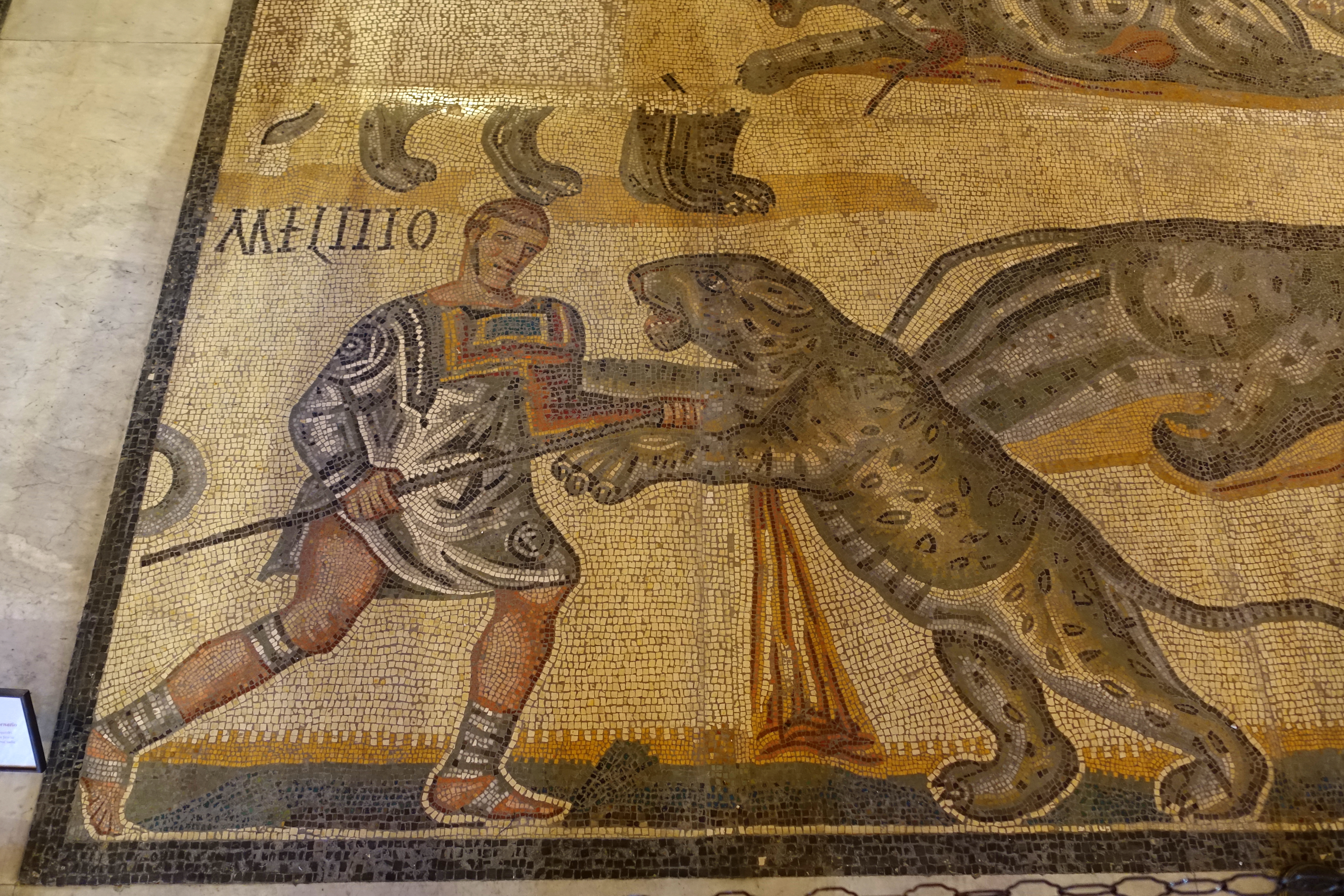
What if it was a bestiarius? Few figures are more emblematic of Roman history than gladiators. However, not all performers trained to entertain the public fought in hand-to-hand combat. There were also charioteers and acrobats. Meanwhile, bestiarii fought exotic animals in the arena.
“Roman amphitheatres also staged ‘beast hunts’ (venationes), which pitched people against animals, a spectacle lasting from the Republican period until late antiquity,” researchers say in an article published in PLOS One.
Gladiator vs. big cats. During these shows, bestiarii showcased their strength by hunting animals in front of an audience. This included tigers, leopards, bears, elephants, wild boars, stags, bulls, and lions. Animals were used for combat and for “spectacular mutilation.” They were also the agents of execution of criminals during the brutal damnatio ad bestias, which translates to “condemnation to beasts.”
With all this evidence, Thompson and his colleagues reached a fascinating conclusion about the bitten skeleton found in York. It likely belonged to a gladiator who fought a big cat in a combat arena as part of a Roman spectacle.

Why it matters. According to researchers, the York bone is “the first osteological evidence of human interaction with large carnivores in a combat or entertainment setting in the Roman world.” Historians had previously seen images of wrestlers being attacked by lions in mosaics and ceramics. They also have known of wild beast fights from historical texts. However, the bite marks on the pelvis provide new insights into these spectacles in Rome.
“While images of gladiators fighting lions have appeared in ancient mosaics and pottery, this is the only convincing skeletal evidence from the Roman world of bite marks produced by the teeth of a large cat, detected thanks to innovative forensic work,” co-author John Pearce explains. Researchers insist on the importance of the findings as the first “compelling skeletal evidence.”
Evidence. Previously, archaeologists only had clues about the existence of animal spectacles derived from scattered mosaics, ceramics, and historical accounts. The York bone has now provided concrete evidence. “For years, our understanding of Roman gladiatorial combat and animal spectacles has relied heavily on historical texts and artistic,” Thompson explaines.
He also points out that this finding “[reshapes] our perception of Roman entertainment culture” in Britain. It raises several intriguing questions: How common were exotic animals in the region? How were they transported? What impact did they have on the environment?
From Africa to England. “The logistics of transporting live large animals from the Mediterranean to Northern England must have been complicated and expensive, likely piggy-backing on military supply routes,” Pearce explains. He adds, “If North Africa is being plundered for its big cat apex predators, not just for games in Rome but also for the Northern provinces of the empire too, then the ecological implications are significant. For every lion brought for games for York (or other Roman cities and camps such as London, Cologne, or Carnuntum), many more must have expired en route.”
Images | Kevin Olson | Wikimedia Commons | Maynooth University