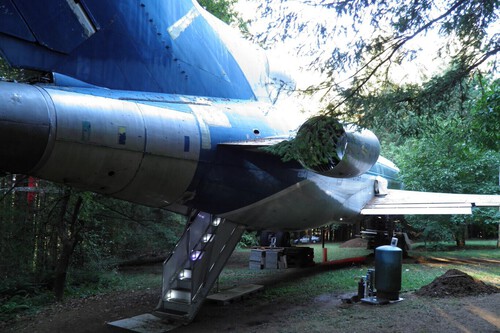

Adapted by:
Javier Márquez
WriterI've been in media for over a decade, but I've been marveling at the possibilities that technology brings us much longer. I believe we live in a world where the digital revolution is changing everything and that Xataka is the best place to write about it.

Alba Mora
WriterAn established tech journalist, I entered the world of consumer tech by chance in 2018. In my writing and translating career, I've also covered a diverse range of topics, including entertainment, travel, science, and the economy.
Can you imagine spending the rest of your life inside an airplane? Not flying or traveling from one destination to another, but truly living in it day after day, just like a real home. This was the aspiration of Bruce Campbell, a retired electrical engineer who now resides in a Boeing 727 located in a forest outside Portland.
A commercial airliner is typically dismantled at the end of its useful life. The most valuable components, such as engines, avionics systems, and landing gear, are usually salvaged. However, the airframe is often left to sit for years in one of the world’s aircraft graveyards, even though recycling initiatives for aluminum and titanium parts exist.
Campbell wasn’t satisfied with the idea that the complex and sophisticated structures of commercial aircraft would end up scrapped and forgotten in a remote desert corner. He believed that if planes could no longer fly, they could still serve a useful purpose as living spaces. With this vision in mind, he purchased the fuselage of a retired airliner, including several internal components, in 1999. According to USA Today, he paid $100,000 (about $190,000 today) for the entire aircraft.
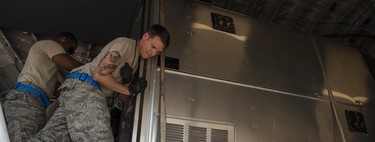
A Boeing 757 Converted into a Home
Purchasing the plane was just the beginning. The next challenge was moving it to its new location. To do this, the aircraft had to be partially disassembled and transported by truck to Campbell’s farm outside Portland. Once there, he reassembled piece by piece among the trees and vegetation. Today, the plane rests on a support structure that connects to the landing gear and wings.
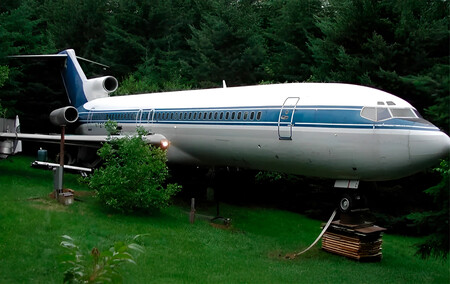
Campbell retained much of the aircraft’s original design, including seats and overhead compartments. Visitors enter through one of the emergency doors and walk down the central aisle. The inhabited space is filled with everyday objects: a microwave, a table, and a refrigerator. There are also several computers, including an Apple Macintosh SE from the late 1980s. Visitors can use it to leave a message.
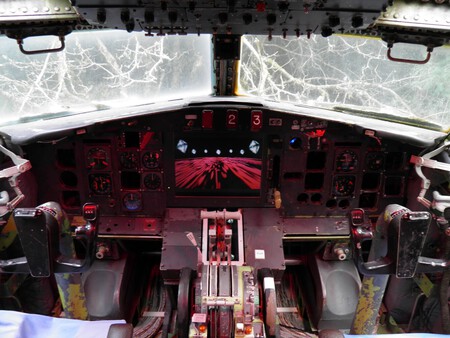
One of the most striking areas is the cockpit, where several of the original controls are still preserved. The thrust levers, yoke, and much of the instrument panel remain intact, almost as if the plane were ready to take off. The wiring and electrical systems are completely exposed elsewhere in the interior, reflecting Campbell’s background as an electrical engineer.
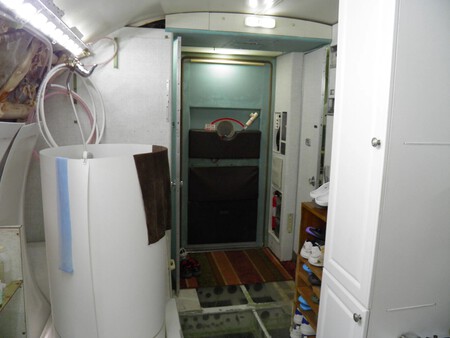
Far from keeping his unique home as a personal retreat, Campbell has been welcoming visitors for more than two decades. For those who approach with curiosity, he offers a short tour of the airplane-turned-home, sharing his vision and lifestyle.
Notably, the airplane Campbell bought is a Boeing 727, a narrow-body aircraft produced from 1962 to 1984. It was widely used for domestic and medium-range international routes, with a range of up to 2,900 miles in its most advanced versions. Boeing 727 became one of the most popular models of its time, with more than 1,800 units produced. However, many were retired in the 1990s because airlines began to replace them with more efficient models.
Images | AirplaneHome/Bruce Campbell