
Adapted by:
Rubén Andrés
WriterWriter at Xataka. I've been working remotely for more than a decade and I'm a strong advocate of technology as a way to improve our lives. Full-time addict of black, sugar-free coffee.

Alba Mora
WriterAn established tech journalist, I entered the world of consumer tech by chance in 2018. In my writing and translating career, I've also covered a diverse range of topics, including entertainment, travel, science, and the economy.
In the tech sector, major companies have had notable rivalries vying for dominance. Examples include Intel and AMD, Sony and Nintendo, Nvidia and AMD, and naturally, Apple and Microsoft. Former CEOs Steve Jobs and Bill Gates represent that competition.
However, beyond the fierce business rivalry for market supremacy between PCs and Macs, Gates and Jobs developed a unique relationship founded on mutual respect and recognition.
Complementary Adversaries
Microsoft and Apple have always been rivals. However, the two companies have also collaborated on several occasions to develop products. Despite these collaborations, such as bringing Office to the Macintosh, the public perception of Jobs and Gates as irreconcilable enemies has persisted. This is far from true.
In an interview on Jay Shetty’s podcast, On Purpose, Gates revealed that Jobs and he were complementary, which enabled them to work together on several projects.
“I had a fantastic relationship with Steve. Early on, I got to do the [BASIC software] that went with every Apple II computer. I worked with both Jobs and [Steve] Wozniak to get that done. Then later, as Steve [had] a kind of small group inside Apple doing the Macintosh, he invited Microsoft to write application software (a spreadsheet, a word processor) for it… We worked very closely on that project, and he and I loved the fact that it ended up being a key Apple product,” Gates explained.
The Microsoft founder pointed out that although they were very competitive, they also admired each other. Jobs apparently felt the same way about Gates.
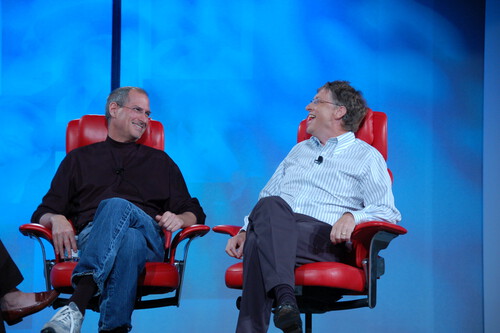
In a historic interview at the D5 Conference in 2007, The Wall Street Journal brought together Jobs and Gates on stage. During the conversation, Jobs quoted The Beatles’ song Two of Us, saying, “‘You and I have memories longer than the road that stretches out ahead,’ and that’s clearly true here.”
Gates explained the enduring and complex relationship between himself and Apple’s co-founder, stating that they were complementary to one another. “What he was super good at, I wasn’t good at,” Gates added.

Without Apple and Microsoft, the Landscape of Computing Would Be Very Different
The visions of Microsoft and Apple regarding what a computer should be were notably distinct and reflected the strengths of their respective leaders. Apple prioritized design and efficiency, while Microsoft aimed to create a platform for its software, aspiring to bring a computer into every home.
“His taste in design and user interface, and even his intuition about people–he was a genius in a way you can’t explain. He didn’t look at the code and write code…,” Gates explained. However, as an engineer, Gates aimed to make that code “faster and smaller.”
Their rivalry and differing concepts of computing propelled the industry to its current level of maturity, with both companies reaching market capitalizations in the $3 trillion range. This success would likely have been unattainable without the competitive drive that characterized the late 1990s and early 2000s.
Gates acknowledged that he and Jobs believed computers would transform and enhance education. However, he also recognized that initiatives to improve computer usage weren’t always successful.
“I think both of us [were] thankful for what we’d been able to work on… We got more of a front row seat and helped build this thing,” Gates told Shetty, reflecting on his last conversations with Jobs before his death in 2011.
In their joint appearance in 2007, Jobs described his view of the Apple-Microsoft competition in the late 1990s: “What was clear was that if the game was a zero-sum game, where for Apple to win, Microsoft had to lose, then Apple was going to lose... A lot of people’s heads were still in that place at Apple and even in the customer base… It was clear that you didn’t have to play that game because Apple wasn’t going to beat Microsoft. Apple didn’t have to beat Microsoft. Apple had to remember who Apple was because it had forgotten.”
Image | David Geller